You probably don’t need to guess whether AI is already being used somewhere in your business without your knowledge. You need to know how visible it already is — and that’s actually good news, because the answer is usually more findable than owners expect.
This is the core of what’s called shadow AI risk: employees, contractors, or even entire departments using AI tools for work without going through any formal review or approval. It’s rarely done with bad intent. Most people adopting an AI tool on their own are just trying to get their work done faster. But when a business doesn’t know where its data is going, how long it’s being kept, or what a tool is capable of doing with it, that well-intentioned shortcut becomes a real exposure.
Here’s the part most articles on this topic skip: small businesses are actually better positioned to get ahead of shadow AI risk than large enterprises are — but only if they act while the problem is still small enough to see clearly. That window doesn’t stay open forever.
What Shadow AI Actually Is (and Why It’s Sneakier Than It Sounds)
Shadow AI is the AI-era version of an older problem called “shadow IT” — technology employees adopt on their own, outside official approval. The difference is that shadow IT usually meant someone installed an app or signed up for a free file-sharing account. Shadow AI is quieter and harder to spot, because AI features are increasingly built directly into tools a business already uses and trusts.
Think about it this way: a CRM your sales team has used for years might quietly roll out an “AI summarize” button in an update. A note-taking app might add an AI meeting assistant by default. A browser extension installed months ago for something unrelated might now include an AI feature nobody asked for or noticed. None of these show up as “a new AI tool was installed” — they show up as “the same software you always trusted just started doing something new with your data.”
That’s why “we don’t really use AI tools” is often already untrue for a lot of small businesses, even when leadership genuinely believes it.
5 Signs Shadow AI Is Already Happening in Your Business
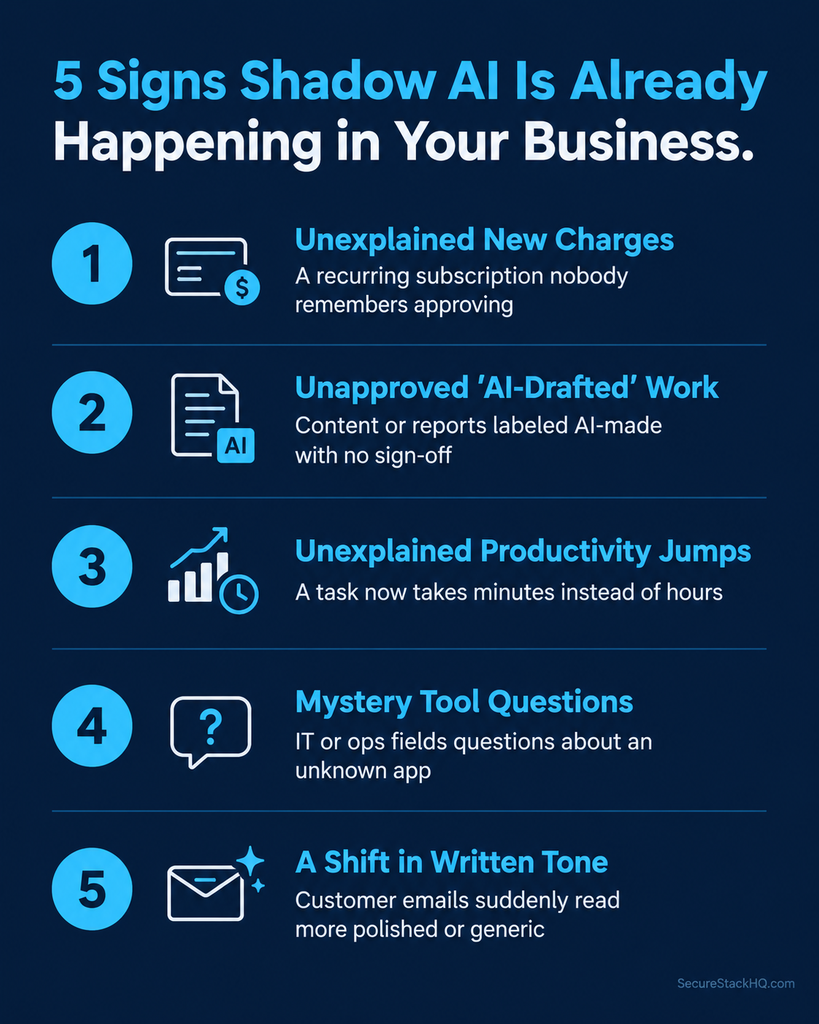
You don’t need a security audit to start noticing this. A handful of everyday signals tend to show up well before anyone officially “discovers” a shadow AI problem:
- Unexplained new charges on the company card. A recurring $15-$40/month subscription nobody remembers approving is one of the most common early signs — someone on the team likely signed up for an AI tool independently to solve an immediate problem.
- Work that references “AI-drafted” or “AI-summarized” content nobody approved. If someone mentions in a meeting that a document was “AI-generated” or a report was “summarized with ChatGPT,” and nobody asked which tool, that’s shadow AI already in motion.
- A sudden productivity jump with no process change behind it. If a task that used to take a team member two hours now consistently takes twenty minutes, and nothing about your official workflow changed, it’s worth a friendly, non-accusatory question about how.
- IT or operations gets asked questions about a tool nobody purchased. Even in a small business without a dedicated IT team, this shows up as “does anyone know why this app is asking for calendar access” or similar low-key confusion.
- A stylistic shift in customer-facing content or emails. A noticeably different tone in outgoing communications — more polished, more generic, or oddly consistent across different team members — can indicate AI writing tools are already part of daily work, sanctioned or not.
None of these signs are proof of a serious problem on their own. But if two or three of them sound familiar, shadow AI risk isn’t a hypothetical for your business anymore — it’s already active, just unmapped.
Why This Matters More Than It Used To
Shadow AI itself isn’t new as a concept, but the stakes attached to it have shifted noticeably in 2026. IBM’s 2026 Cost of a Data Breach Report found that shadow AI was involved in 43% of breached organizations’ incidents this year, more than double the 20% recorded the year before. The same report found that 68% of breached organizations had no policy in place to govern AI use or manage shadow AI at all — meaning the businesses getting hit usually didn’t have a policy gap so much as no policy at all.
Regulation has also caught up faster than expected. Most remaining provisions of the EU AI Act began applying in August 2026, and Colorado’s own AI Act became enforceable mid-year. If your business handles EU customer data or operates across state lines, “we didn’t know employees were using that” is becoming a weaker answer to give a regulator than it used to be.
Real Incidents That Show the Risk Is Real
Two examples illustrate how this plays out at very different scales.
At Samsung, employees reportedly entered sensitive proprietary source code into a public AI chatbot while trying to get help with their work — leading the company to restrict generative AI tool use internally afterward. It’s a clean example of the core shadow AI problem: no malicious intent, just someone trying to solve a problem, with sensitive data ending up somewhere it was never meant to go.
At a larger scale, Italy’s data protection authority temporarily blocked a major AI chatbot entirely over privacy concerns, before access was later restored. That’s a useful reminder that shadow AI isn’t only a company-level risk — it can escalate into a national regulatory story when enough data handling questions go unanswered.
The Small Business Advantage — Why You Can Get Ahead of This
Here’s the part worth sitting with: a large enterprise trying to address shadow AI usually has to work through multiple departments, legal review, procurement processes, and layers of approval before anything changes — a process that can take months or quarters even when everyone agrees action is needed.
A small business doesn’t have that problem. If you own or run a small business, you can realistically put a lightweight AI-use policy in place in a matter of days, not quarters — because you don’t need six departments to sign off. That’s a genuine structural advantage, and it’s one most small business owners don’t realize they have until someone points it out.
A workable starting policy doesn’t need to be complicated. It can be as simple as a short list of AI tools employees are approved to use for work, plus a plain-language rule about never pasting customer data, financial information, or proprietary content into any AI tool that isn’t on that approved list. Add one more piece: an easy, non-punitive way for employees to ask “can I use this tool for this?” without fear of getting in trouble for having tried to be more productive in the first place.
The goal isn’t to ban AI — it’s to make the sanctioned path easier and more obvious than the unofficial one, so people don’t feel like they have to go around you to get their work done.
Conclusion
Shadow AI risk isn’t really a story about employees doing something wrong. It’s a story about visibility — knowing where AI is already touching your business, and building a simple enough policy that people actually follow it instead of working around it. The five signs above are a reasonable starting point for figuring out where you actually stand, not a hypothetical checklist.
This risk doesn’t exist in isolation, either. If you haven’t already, it’s worth reading through our guide on AI vendor risk assessment to evaluate the AI tools you already know about, and our explainer on prompt injection risk to understand what can go wrong once AI tools have real access to your systems. Together, these three risks point to the same underlying habit worth building: knowing what’s touching your data, and why.
Pingback: EU AI Act Compliance: Your Best 5-Minute Guide
Pingback: Best Vendor Risk Management Software: A 2026 Guide
Pingback: ChatGPT Business Data Privacy: Best 3-Minute Fix Guide
Pingback: Agentic AI Risks: Best 2026 SMB Guide
Pingback: 7 AI Privacy Concerns Every Small Business Must Fix