A law firm adds a single line to its engagement letter: “We may use artificial intelligence tools to assist with your matter.” The partners consider the AI question handled. Here’s a three-question test to check whether it actually is.
ABA Formal Opinion 512, issued July 29, 2024, is the American Bar Association’s first formal guidance on lawyers’ use of generative AI — and it says something most firms haven’t caught up to: for AI tools that learn from what’s put into them, a generic disclaimer does not count as informed consent. A firm can have a policy, a signed engagement letter, and still fail this test without knowing it.
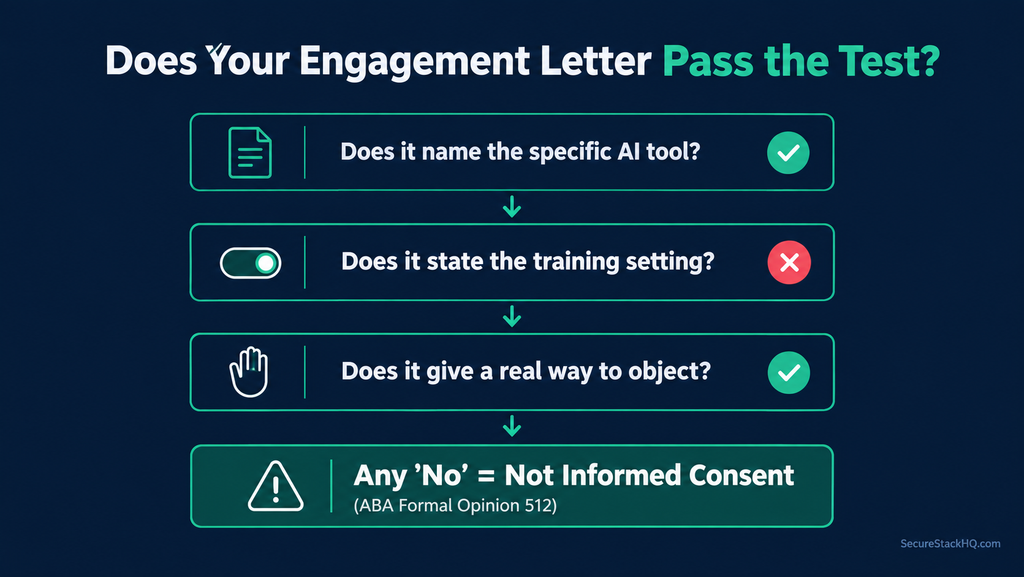
The 3-Question Consent Audit
Pull up your firm’s current engagement letter or AI policy and answer honestly:
- Does it name the specific AI tool(s) your firm actually uses — not just “AI” in the abstract?
- Does it state whether that tool trains on submitted data, and confirm which plan/tier your firm is on?
- Does it give the client a real, specific way to object to AI being used on their matter — not just a passive disclosure?
If any answer is no, per ABA Formal Opinion 512, your firm likely doesn’t have informed consent yet — regardless of what the engagement letter says.
What ABA Formal Opinion 512 Actually Requires
The opinion doesn’t create new rules. It applies existing ABA Model Rules of Professional Conduct directly to generative AI use. The three duties with the most immediate operational impact:
- Confidentiality (Rule 1.6): applies to AI tools the same way it applies to any other third-party service. For “self-learning” tools that may use client inputs to improve future outputs, a lawyer must obtain the client’s informed consent before entering confidential information — explaining the specific tool, the specific risk, and the specific kind of information involved. That’s exactly what the 3-question audit above checks.
- Competence (Rule 1.1): a lawyer must reasonably understand an AI tool’s capabilities and limitations before relying on it. The opinion states plainly that uncritical reliance on AI output is “almost certainly malpractice.”
- Candor to the Tribunal (Rule 3.3): every AI-assisted filing must still be independently verified — this is the rule behind widely reported sanctions for AI-hallucinated case citations submitted to courts.
Billing Ethics and Supervision — The Two Duties Firms Overlook
Confidentiality gets most of the attention, but Opinion 512 is just as direct about two other obligations:
Billing (Rule 1.5):
- If a task that used to take three hours now takes forty minutes with AI assistance, you bill for the actual time spent — not the time you would have billed before AI. Opinion 512 quotes ABA Formal Opinion 93-379 directly on this point: a lawyer billing hourly “does not fulfill her ethical duty if she bills the client for more time than she has actually expended.”
- Integrated AI subscriptions your firm pays for as a flat cost are generally treated as firm overhead, not a separately billable disbursement — passing that cost directly to a client as a line-item expense needs to be explicitly agreed to in advance, not assumed.
- The same reasonableness standard extends to flat and contingent fees: a flat fee set before AI use may no longer be reasonable once AI materially compresses the work involved.
Supervision (Rules 5.1 & 5.3):
- Partners and supervising attorneys are responsible for having actual policies in place — not just an assumption — that prevent associates and paralegals from pasting confidential client data into unapproved consumer AI tools. This is the direct mechanism by which unmonitored shadow AI exposure enters a firm: not through a rogue decision at the top, but through nobody having set a rule for the people doing the day-to-day drafting.
The Privilege Problem Underneath the Consent Problem
This connects to something we’ve covered before in a different context: our guide to ChatGPT business data privacy explained how pasting confidential material into a consumer AI tool can count as third-party disclosure — a contract problem for most businesses. For a law firm, the same mechanism carries a heavier consequence: attorney-client privilege and work-product protection can be waived the moment privileged material is voluntarily disclosed to a third party, and a consumer-grade AI tool with training enabled is exactly that kind of third party.
This is also the same “authorized tool, unvetted setting” blind spot we described in our shadow AI risk guide — except here, nobody needs to have snuck in an unapproved tool. The firm’s own sanctioned AI use can create the exposure if the consent and supervision behind it were never actually in place.
It’s Not Just the ABA
Formal Opinion 512 isn’t binding law — it’s persuasive authority that interprets the Model Rules each state separately adopts. But state bars have reached similar or stricter conclusions independently. The Florida Bar’s Ethics Opinion 24-1 and the New York City Bar Association’s Formal Opinion 2024-5 both arrive at comparable confidentiality obligations for lawyers using generative AI. This isn’t one committee’s opinion in isolation — it’s a cross-jurisdictional pattern, and disciplinary bodies increasingly treat Formal Opinion 512 as the reference point even where it isn’t formally adopted.
Enterprise Procurement Checklist for Law Firms
Before signing with any AI vendor, confirm these three items directly in the contract or SLA — not just in marketing material:
- Zero Data Retention (ZDR): does the vendor contract explicitly guarantee zero-day data logging for training or human review, or just a vague “we take privacy seriously” statement?
- API vs. web interface: standard web browser subscriptions often retain conversation history for quality checks even on paid tiers. A dedicated enterprise API endpoint or self-hosted instance isolates data streams far more completely — know which one your firm is actually contracted for.
- Jurisdiction and storage: confirm client data remains in authorized regional data centers, particularly for any matter involving cross-border data transfer obligations.
Purpose-Built Legal AI vs. Consumer Tools
Formal Opinion 512 doesn’t prohibit using general-purpose tools like ChatGPT for legal work — it requires meeting the duties above. Tools built specifically for legal practice (Harvey, CoCounsel, and similar platforms) are generally designed around confidentiality and non-training defaults from the start, which meaningfully lowers the compliance burden compared to a consumer chatbot account. That’s a different calculation than a typical software comparison — here, the deciding factor is professional-responsibility exposure, not just price or features.
Fixing a Failed Answer
If your firm’s engagement letter failed any part of the 3-question audit, here’s what a clause that passes actually looks like:
Sample language: “[Firm Name] may use [specific AI tool] to assist with research and drafting on your matter. This tool is configured on a [business/enterprise] tier that does not use submitted data to train its underlying models. If you would prefer this tool not be used in connection with your representation, please notify your attorney in writing.”
Notice what it does that a generic clause doesn’t: names the tool, states the training status, and gives a real path to object. That’s the whole test, answered in one clause.
Closing
For most businesses, an AI privacy misstep is a contract and reputation problem. For a law firm operating under ABA Formal Opinion 512 and the parallel state bar opinions building on it, the same misstep can reach the privilege protecting the client’s case itself — and touch billing ethics and supervisory duties at the same time. Run the 3-question test on your own engagement letter today, and check it against the confidentiality practices covered in our ChatGPT business data privacy guide — the fix, once you know what’s missing, takes one paragraph.
For the full text, see ABA Formal Opinion 512.