Answer three questions and you’ll know more about your actual EU AI Act compliance exposure than most compliance sales pitches will tell you. That’s not an exaggeration — a lot of the content written about this law is produced by firms selling expensive compliance services, and it tends to make the obligations sound heavier and more universal than they actually are for most small businesses.
The EU AI Act is real, it carries genuinely large fines for the businesses it applies to most strictly, and it deserves to be taken seriously. But “taken seriously” and “panic-inducing” aren’t the same thing, and for a lot of small businesses using AI tools day to day, the honest answer to “does this apply to me” is: only in a limited, manageable way.
The 3-Question EU AI Act Compliance Test
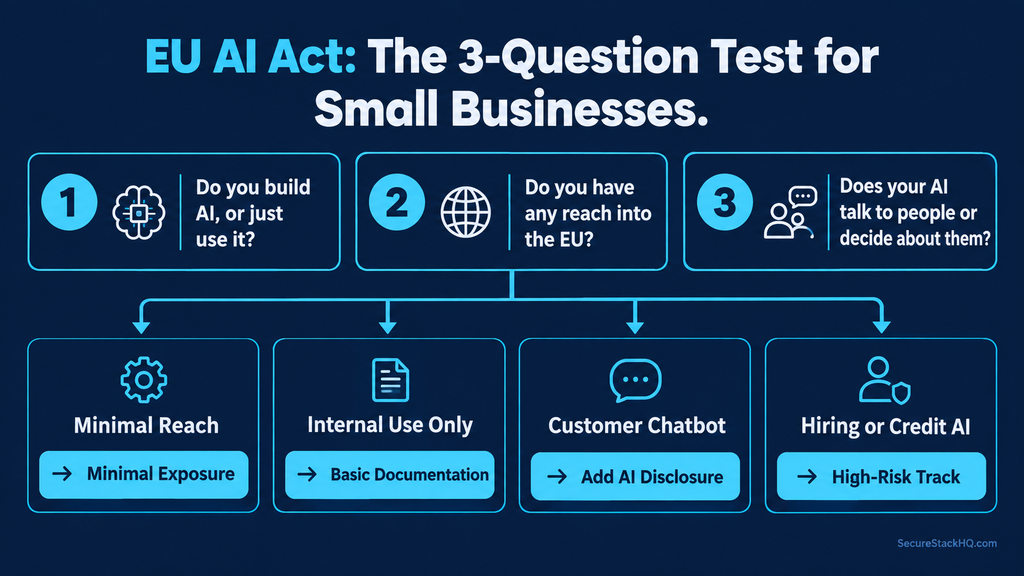
Before diving into deadlines and penalties, run through these three questions. Most small businesses will answer in a way that puts them in the lighter-obligation category — worth knowing before anything else.
Question 1: Do you build and sell AI systems, or do you just use tools someone else built?
If your business develops its own AI models or products to sell, you’re what the Act calls a “provider,” and heavier obligations apply. If you’re using ChatGPT, Microsoft Copilot, an AI feature inside your CRM, or similar off-the-shelf tools, you’re a “deployer” instead — a much lighter category. Most small businesses are deployers, not providers.
Question 2: Does anyone in the EU ever see or interact with output from an AI tool you use?
The Act applies extraterritorially — meaning it can apply to a business anywhere in the world if the output of an AI system it uses reaches someone in the EU, even if the business itself has no EU office or EU customers by design. If you have any EU-based clients, subscribers, or users who might see AI-generated content, communications, or decisions from your business, this question matters. If genuinely none of your business touches the EU in any way, your exposure is minimal regardless of the other answers.
Question 3: Does your AI tool interact directly with people, or make automated decisions about people?
This is the question that decides whether you have real, concrete obligations right now. A chatbot, AI agent, or virtual assistant that talks directly to customers counts. So does an AI system used for things like automated hiring decisions, credit scoring, or biometric categorization — these sit in the Act’s “high-risk” category. If your AI use is more behind-the-scenes — drafting internal documents, summarizing meetings, analyzing data — you’re less likely to trigger these specific obligations.
Most small businesses land on: deployer, maybe some EU reach, and no high-risk or direct-interaction AI use. That combination means real but limited obligations — mainly awareness and documentation, not the six-figure compliance programs some vendors describe.
Quick Result Summary
Once you’ve answered the three questions, here’s roughly where you land:
- Deployer + no EU reach → Minimal exposure. The Act’s obligations barely touch you.
- Deployer + some EU reach + internal-only AI use → Light obligation: basic documentation of what tools you use and why.
- Deployer + EU reach + customer-facing chatbot/agent → Add a clear AI disclosure (Article 50 transparency rule — covered below).
- Deployer + EU reach + AI used in hiring, credit, or similar decisions about people → The high-risk track — worth preparing ahead of the December 2027 deadline.
What August 2, 2026 Actually Changed
The EU AI Act didn’t arrive all at once — it’s been phasing in since it entered into force in August 2024. Here’s the actual sequence, since a lot of content online blurs these dates together:
- February 2, 2025 — Prohibited AI practices banned, and baseline “AI literacy” obligations began applying.
- August 2, 2025 — Obligations for general-purpose AI (GPAI) models — the category ChatGPT and similar large language models fall under — began applying to newly released systems.
- August 2, 2026 — The Act’s general application date, along with Article 50 transparency duties: AI systems that interact directly with people, or that generate synthetic content, must make that fact clear.
- December 2, 2027 — Full high-risk obligations (Annex III systems: things like hiring, credit, and biometric categorization) take effect — this date was pushed back from the original 2026 timeline by a simplification package called the Digital Omnibus.
- August 2, 2028 — The final deadline, covering AI embedded in already-regulated products like medical devices and industrial machinery.
For most deployers without high-risk AI use, August 2026’s transparency rule is the one that actually matters day to day: if you use a customer-facing chatbot or AI agent, people need to be told they’re talking to AI, unless that’s already obvious from context.
The SME Relief Provisions Nobody Mentions
This is the part that rarely makes it into fear-driven marketing copy, and it’s worth knowing:
- Penalties are proportionally reduced for SMEs. For most violations, large companies face fines up to the higher of a fixed amount or a percentage of global turnover. For SMEs and startups, it’s the lower of the two that applies instead — a meaningful, deliberate difference built into the law.
- Free, priority access to regulatory sandboxes. These are structured environments for testing AI systems with reduced administrative burden, and SMEs get priority placement at no cost.
- A dedicated simplification effort aimed specifically at reducing SME burden. The European Commission’s 2025-2026 “Digital Omnibus” package was explicitly designed to cut administrative burden by at least 25% overall, and 35% specifically for smaller businesses — and it’s what pushed the toughest high-risk deadlines back by well over a year.
The law was written with an awareness that most of the EU economy is small and mid-sized businesses, not tech giants, and the relief provisions reflect that — something worth knowing before assuming the worst.
If You Answered “Yes” to Question 3
If your business does have a customer-facing chatbot, AI agent, or an AI system involved in decisions about people, here’s what actually needs attention — scoped only to what’s relevant, not a generic checklist everyone has to follow regardless of their situation:
Add a Clear Disclosure
If customers interact with an AI chatbot or agent, a simple, visible notice that they’re talking to AI is typically enough to satisfy the transparency requirement — this doesn’t need to be complicated or legally dense. A short line placed near your chat widget works well, for example:
“You’re currently chatting with an automated AI assistant. For a human, email us at [your support email].”
Document What the AI Tool Actually Does
A short internal record of which AI tools are in use, what they’re used for, and who’s responsible for them puts a business in a far better position than having no documentation at all if questions ever come up.
Verify Your Vendors Are Actually Compliant
If you’re a deployer using someone else’s AI system, part of your own diligence is confirming the provider has done their part — this overlaps directly with the AI vendor risk assessment process worth running on any AI tool your business relies on.
Revisit This If Your AI Use Changes
Adding a new AI feature, especially one that touches hiring, credit, or biometric data, can shift which category your business falls into — worth a quick re-check of the 3-question test above whenever that happens.
Conclusion
The EU AI Act is a real law with real consequences for the businesses it targets most heavily, but for the average small business using off-the-shelf AI tools, the actual obligations are narrower and more manageable than a lot of compliance-sales content suggests. The 3-question test above is a genuinely useful five-minute exercise — most small businesses will find they’re in the lighter-obligation category, with the biggest practical task simply being a clear AI disclosure where it’s actually needed.
This connects directly to the other AI risks worth understanding as a small business: our guide on AI vendor risk assessment covers how to evaluate whether an AI vendor is actually handling your data and compliance obligations responsibly, and our explainer on shadow AI risk covers what happens when AI tools get adopted without anyone checking questions like these in the first place.
Pingback: ChatGPT Business Data Privacy: Best 3-Minute Fix Guide
Pingback: Automated Employment Decision Tools: Best 2026 Guide