Small businesses are adopting AI tools faster than most owners realize — a customer support chatbot here, an AI writing assistant there, an AI-powered feature quietly added to a CRM you already use. Each one of these tools now touches your business’s data in some way. Most small businesses never formally check whether that’s actually safe.
An AI vendor risk assessment is simply a structured way to answer one question before (or while) using any AI tool: is this vendor safe to trust with our data and processes? You don’t need a security team or technical background to do this well — you need the right questions and a consistent process. This guide walks through exactly that.
Why AI Vendor Risk Is Different From Regular Vendor Risk
Most small businesses already vet vendors informally — checking reviews, asking about pricing, maybe glancing at a privacy policy. AI vendors introduce a few extra risks that traditional vendor checks often miss entirely.
The biggest one: many AI tools get adopted informally, without any official review at all. An employee signs up for a free AI writing tool, or starts feeding customer questions into a chatbot, without anyone in the business formally approving it. This pattern (sometimes called “Shadow AI”) means a business can be exposed to real risk without leadership even knowing a tool is in use.
The consequences of skipping vendor vetting aren’t hypothetical. In 2024, AT&T suffered a breach that exposed customer contact details, traced back to vulnerabilities in a third-party vendor’s systems — a reminder that a vendor’s security claims and their actual practices aren’t always the same thing.
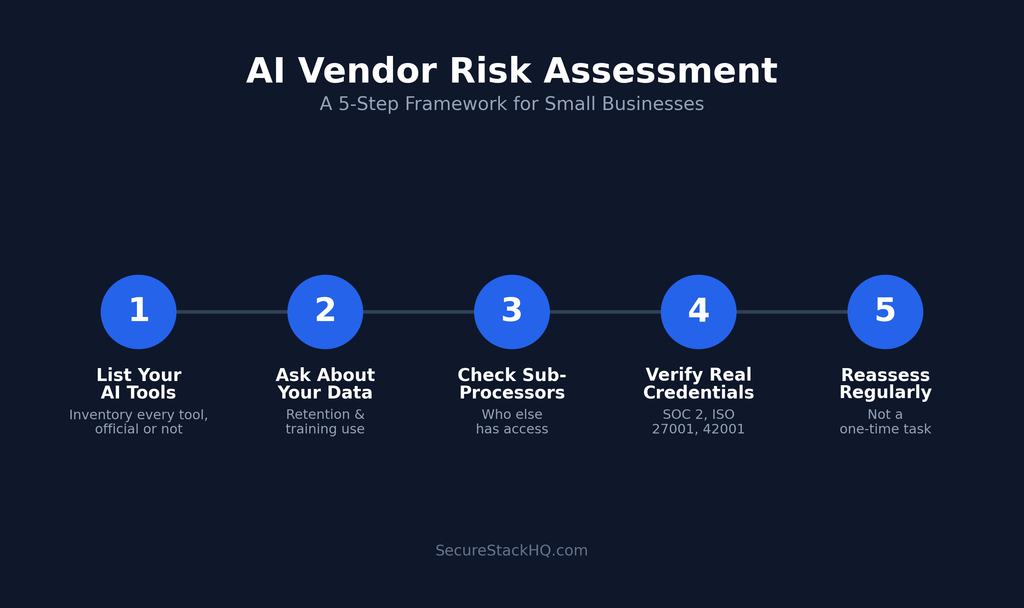
The 5-Step AI Vendor Risk Assessment Framework
Step 1: List every AI tool your business actually uses
Start with a simple inventory — not just tools IT officially approved, but anything your team is actually using: AI chatbots, writing assistants, AI features inside existing software, browser extensions. You can’t assess risk on tools you don’t know exist.
Step 2: Ask exactly what happens to your data
For each tool, get clear answers to:
- Does it store the information you input? For how long?
- Is that data used to train or improve the AI model further?
Get the answers in writing — a vendor’s marketing page isn’t the same as their actual documented data policy.
Step 3: Check who else has access to your data
AI vendors often rely on other companies behind the scenes (sub-processors) — cloud hosting providers, analytics tools, sometimes other AI companies. A vendor’s privacy policy usually discloses this if you know to look for it.
Step 4: Look for real security credentials, not just claims
Marketing pages often say “secure” or “enterprise-grade” without backing it up. Look instead for actual, verifiable certifications — SOC 2, ISO 27001, or AI-specific standards like ISO 42001, which specifically requires companies to document how they assess the AI systems they use.
Step 5: Reassess regularly — this isn’t a one-time task
AI vendor relationships change faster than typical software vendors. A model update, a change in terms of service, or a reported security incident should all trigger a fresh look — not just an annual review out of habit.
Red Flags to Watch For
- The vendor won’t clearly answer how long they retain your data
- Vague or evasive answers about whether your data trains their model
- No real security certification, just general reassurances
- No documented process for what happens if there’s a data breach
If you hit two or more of these with a vendor already in use, it’s worth pausing and getting clearer answers before continuing.
How Often Should You Reassess
At minimum, once a year. But treat these three events as automatic triggers for an earlier reassessment:
- The vendor releases a new AI model version
- Their terms of service or privacy policy changes
- Any reported security incident, even a minor one
Conclusion
AI vendor risk assessment doesn’t need to be complicated — a consistent, five-step process catches most of the real risk without requiring a security background. Start with a simple inventory of what your team is actually using, ask the right questions, and revisit it periodically rather than treating it as a one-time checkbox.
Pingback: 6 Essential Steps to Reduce Prompt Injection Risk
Pingback: Shadow AI Risk: 5 Warning Signs to Watch For
Pingback: EU AI Act Compliance: Your Best 5-Minute Guide
Pingback: Best Vendor Risk Management Software: A 2026 Guide
Pingback: AI Acceptable Use Policy: 5 Essential SMB Rules