Search for guidance on NYC’s AI hiring law, and you’ll find dozens of guides confidently stating that any employer hiring a remote candidate who lives in New York City is automatically covered — regardless of where that employer is based. That’s not quite what New York City’s Department of Consumer and Worker Protection (DCWP) actually says, and even law firms have flagged the ambiguity. If your business uses automated employment decision tools, knowing the real trigger matters more than the version repeated across most blog posts.
What Actually Triggers Local Law 144 (Straight From DCWP’s Own FAQ)
According to DCWP’s official FAQ, Local Law 144 applies when a job is used “in the city,” which means one of the following is true:
- The job location is an office in NYC, at least part time, or
- The job is fully remote, but the position is associated with an office in NYC, or
- The employment agency using the tool is located in NYC (or, if not, one of the above is still true)
The key detail most third-party guides skip: this is about where the employer’s office is, not simply where the candidate happens to live. A business with zero NYC presence hiring a remote candidate who lives in Brooklyn isn’t automatically triggering the law on that basis alone — though DCWP’s own guidance has drawn criticism from employment law firms for language that arguably could be read more broadly, which is part of why the confusion persists.
Two more distinctions DCWP’s FAQ makes clear, and that most summaries blur together:
- The notice-vs-audit dual track: having an NYC office (or a remote role tied to one) triggers the bias audit requirement for the tool itself, full stop — but the 10-business-day advance notice requirement applies specifically to candidates who are NYC residents. You audit the tool before using it on anyone for that role; you only send the notice to the applicants who actually live in NYC.
- Sourcing and outreach are excluded: the law does not cover tools used solely for passive talent sourcing, scanning unapplied resume databases, or general outreach. It applies only once someone has actually submitted an application for a specific position.
What Are Automated Employment Decision Tools (AEDTs)?
What is an AEDT? An automated employment decision tool (AEDT) is DCWP’s official term for any computer-based tool that uses machine learning, statistical modeling, data analytics, or artificial intelligence to help make hiring or promotion decisions, and that substantially assists or replaces human discretion in that decision. This includes resume-ranking software, video-interview scoring tools, chatbot-based candidate screening, and skills or personality assessments with algorithmic scoring — used at any point in the hiring process, not just the final decision.
The Real Risk Is Having Any NYC Office At All
If your business has even one NYC-based office — even a small satellite location — and posts a fully remote role associated with that office, you’re in scope for that posting. This is true regardless of where the candidate you eventually hire actually lives. This is the detail most small businesses miss: it’s not about tracking down every candidate’s home address, it’s about knowing whether the role itself is tied to an NYC office.
The AEDT Definition Is Broader Than You Think
When it comes to automated employment decision tools, the most common surprise for employers isn’t a purpose-built “AI hiring platform” — it’s discovering that a mainstream applicant tracking system they’ve used for years has an AI-powered ranking, recommendation, or “candidate quality score” feature that activates by default. A genuine AEDT inventory across your hiring stack typically finds more in-scope tools than expected, and “our vendor handles compliance” is explicitly not a valid defense — the obligation sits with the employer or employment agency using the tool, not the vendor that built it.
What AEDT Bias Audit Compliance Actually Requires
If your use of an AEDT falls within Local Law 144’s scope, three things are required, at minimum:
- An independent bias audit completed within the past year, calculating selection or scoring rates and impact ratios across race/ethnicity, sex, and intersectional categories
- A public summary of that audit’s results, including the audit date and data sources, posted on the employer’s careers page or a linked page
- Advance notice to NYC-resident candidates — at least 10 business days before use, delivered via job posting, mail, email, or a general notice on the employer’s website
None of these steps can be satisfied by a vendor’s generic marketing claim that their tool is “audited” — the audit must specifically cover your use of the tool, and employers remain responsible for confirming it was actually done.
DCWP also sets a clear priority order for what data the audit can rely on:
| Data source | How it’s used |
|---|---|
| Your own historical usage data | Required as the primary source, if you have enough volume |
| Vendor or pooled data | Allowed if you’re a first-time user of the tool, or lack sufficient historical data of your own |
| Test data | Permitted only when historical data is statistically insignificant, and the audit summary must disclose that test data was used |
Enforcement Is Ramping Up
This isn’t a low-priority, rarely-enforced rule. A December 2025 audit by the New York State Comptroller reviewed 32 companies for nyc bias audit law compliance and found 17 instances of likely non-compliance that DCWP’s own enforcement process had missed — DCWP itself had flagged just one. Employment counsel have read this as a signal that a stricter enforcement phase, with more frequent investigations, is coming. Penalties run $500 to $1,500 per violation, with each day of non-compliant use and each un-notified candidate potentially counted separately — the kind of exposure that compounds quickly if compliance has been assumed rather than confirmed.
The 3-Question Compliance Check
Answer honestly about your own hiring process:
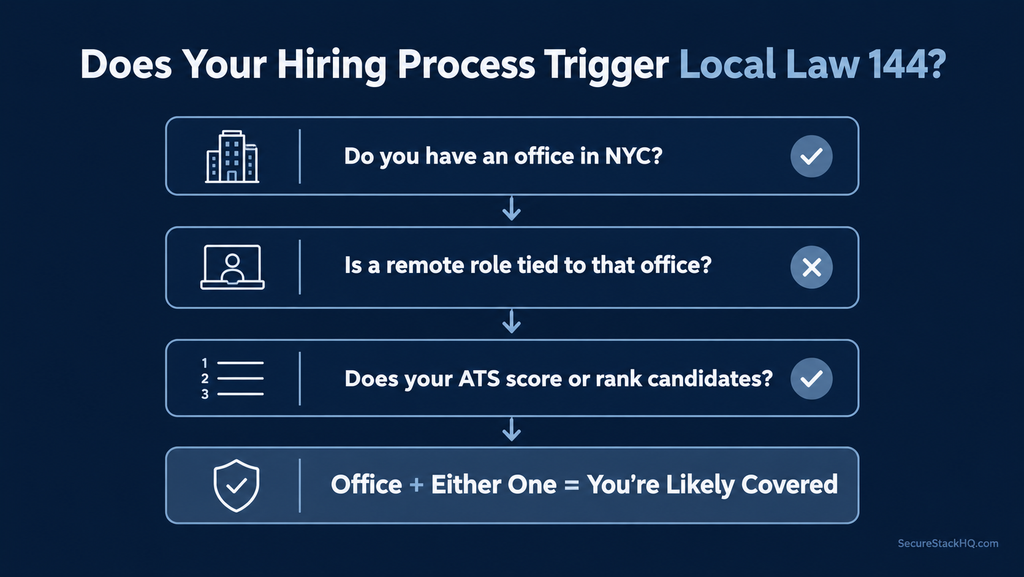
- Does your business have any office located in NYC — even a small one?
- Have you posted, or do you plan to post, a fully remote role associated with that office?
- Does your applicant tracking system have any scoring, ranking, or recommendation feature — even one you’ve never actively configured?
If you answered yes to question 1 and either 2 or 3, your use of automated employment decision tools likely falls within Local Law 144’s scope — and it’s worth confirming whether your current hiring tools have had a bias audit within the past year.
Where This Fits Into a Broader Pattern
This connects to two things we’ve covered before. Our guide to EU AI Act compliance covered a comparable “high-risk” category for employment-related AI use under EU law — the same underlying concern (AI making consequential decisions about people) shows up in both US and EU frameworks, even though the compliance mechanics differ. And our guide to ChatGPT business data privacy covered the same broader theme running through this whole pillar: tools your business already uses can carry compliance obligations nobody checked for, simply because a feature was on by default.
Audit Your Hiring Stack Next
The gap here isn’t a lack of information — it’s that a lot of the information circulating about this law is subtly wrong. Knowing what actually triggers compliance for automated employment decision tools (your office, not just the candidate’s address) and running an honest inventory of your hiring stack’s AI features takes an afternoon. Getting it wrong, per the Comptroller’s own findings, is increasingly likely to get noticed. Start by checking your applicant tracking system’s settings for any scoring or ranking feature, and confirm with your vendor whether it’s been independently audited within the past year.
For the full official guidance, see DCWP’s Automated Employment Decision Tools page and its detailed FAQ (PDF).